

 beananimal
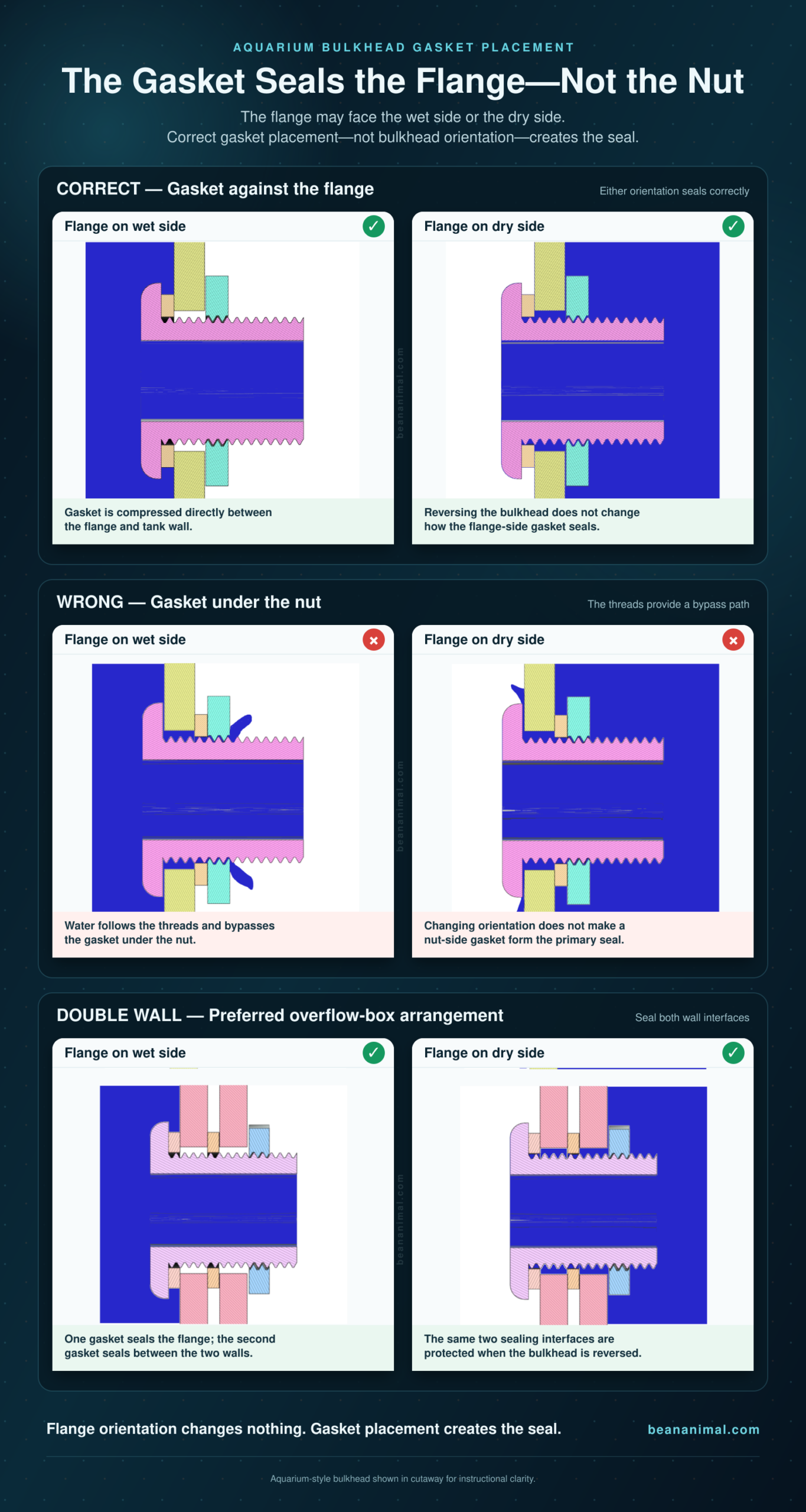
Two rules get repeated constantly: “the flange goes on the wet side” and “the gasket goes on the wet side.” Neither is correct. Both describe one common layout, not the reason it works — and both fail the moment a bulkhead is installed in reverse.
The actual rule: the gasket always goes between the bulkhead flange and the tank wall. The gasket provides a seal between the flange and the tank wall. Tightening the nut pulls the flange against the wall and compresses the gasket between them. That compression is the seal. The nut only supplies the clamping force. Some bulkheads come with a washer to prevent the nut from binding. The washer is not a gasket and does not provide a seal.
Flange, gasket, wall — that’s the sealing path. It doesn’t matter which side is wet.
If you put the gasket under the nut instead, then water travels down the threads and bypasses the gasket. Tightening the bulkhead nut harder doesn’t fix that; it just adds stress to the bulkhead and tank wall.
Double-wall overflow boxes need two gaskets: one against the flange, one between the two walls.
Rule: read the joint, not the slogan. Gasket against the flange.
Ribbed gaskets have a directional face — usually one or two raised concentric rings on one side, flat on the other. The ribbed face goes against the flange. It helps to seal against the uneven surface of the flange by concentrating sealing force at the ribs rather than spreading it evenly. Flipping it backward reduces contact pressure and can leads to leaks.
Follow these simple guidelines for leak free aquarium bulkhead installation:
Do
- Keep the gasket against the flange
- Keep surfaces clean, flat, and free of debris
- Deburr the hole before installing
- Tighten evenly, only enough to compress the gasket
- Support attached plumbing so it doesn’t torque the fitting
- Install ribbed gaskets with raised rings facing the glass.
Don’t
- Put the only gasket under the nut
- Move the gasket based on which side is wet
- Use silicone in place of correct gasket placement
- Tape the retaining threads to try to stop a leak
- Overtighten to compensate for a bad seal
Ribbed gaskets have a directional face — usually a concentric-ring or barbed profile on one side, flat on the other. The ribbed face goes against the flange. It bites into the flange surface and concentrates sealing force at the ribs rather than spreading it evenly, so flipping it backward reduces contact pressure and can leak even when torqued correctly. If the gasket has a printed side or a molded orientation mark, that mark faces out, away from the flange.



Add comment