
 beananimal
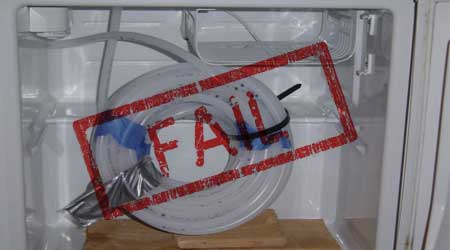
Tank temperatures often rise during the summer months. A common misconception is that a mini refrigerator (“dorm fridge”) can be used as an aquarium chiller. While it may have limited effectiveness on very small systems with modest heat loads (e.g., nano tanks), this article explains why the approach is largely impractical for typical aquariums and continues to be repeated in DIY reefing discussions.
The Short Version
Mini refrigerators are only capable of moving a small amount of heat per hour. The compressors are designed for low duty cycles and relatively low return gas temperatures, not sustained operation under higher heat loads.
Adding coils of tubing or buckets of water does not increase the system’s cooling capacity (BTU/hr). At best, these additions increase thermal mass and shift when heat is absorbed and released. In a system already exceeding the unit’s capacity, this has no meaningful impact on temperature control and may increase cycling frequency.
A dorm fridge may be marginally effective on a nano tank or very small system (roughly ≤30 gallons) with a modest heat load. Beyond that, the capacity and duty cycle limitations become the dominant constraint.
If that is sufficient, the conclusion is straightforward. If not, the following sections walk through the reasoning.
The Long Version
Chillers and air conditioners are often labeled in “horsepower,” which is not useful here. Horsepower describes motor work, not cooling capacity.
What matters is how much heat the system can move over time. That is why cooling systems are rated in BTU/hr (capacity) and EER/COP (efficiency), not horsepower.
Cooling systems do not “create cold.” They move heat. Because of this, a unit using 1000W of electricity can move several times that amount in heat. For example, a 10,000 BTU/hr air conditioner consuming 1,200W moves far more heat than the energy it uses.
Capacity (BTU/hr) is the number that matters.
Mini refrigerators typically have capacities in the low hundreds of BTU/hr. Even small window air conditioners are usually 5,000–8,000 BTU/hr. This is a large difference in available heat removal.
Not all of a refrigerator’s capacity is available externally. Some portion is always used maintaining its internal temperature. The remaining capacity is what can be applied to the tank.
To illustrate, consider a 75-gallon system and a refrigerator capable of ~250 BTU/hr, with roughly 175 BTU/hr effectively available.
That system contains ~637 pounds of water. It takes 637 BTU to change the temperature by 1°F. At 175 BTU/hr, the maximum cooling rate is:
~0.28°F per hour (best case, continuous run)
Now consider a more typical heat load. If the tank rises from 80°F to 84°F over 7 hours, that is a 4°F increase, or:
~2,548 BTU total
~364 BTU/hr of heat gain
The refrigerator can only remove ~175 BTU/hr. The tank is gaining heat at roughly twice the rate it can be removed.
Even under ideal assumptions, the system cannot keep up. Temperature will continue to rise while the unit runs continuously.
The simplified model below assumes linear heat gain and loss for clarity. Real systems are nonlinear, but this does not change the outcome.
The result is near-continuous operation with temperature still exceeding acceptable limits.
Duty cycle is the constraint. Refrigerator compressors are designed for intermittent operation under low load. Sustained high duty cycles increase internal temperatures and shorten lifespan.
As a guideline, continuous heat load should be well below rated capacity—roughly 30–50%—to avoid excessive runtime. For a unit providing ~175 BTU/hr, that implies a usable load of about 50–80 BTU/hr.
For example, a 20-gallon system with a 3°F rise over 8 hours is about 64 BTU/hr. A mid-size refrigerator may handle this. Smaller units will still be overtaxed.
These systems are not designed for continuous external heat removal. They are designed to maintain a cold interior with occasional small heat inputs.
The conclusion remains: dorm refrigerators are only viable for very small systems with modest heat loads. Capacity is the limiting factor.
What is “1 ton of cooling”?
The latent heat of fusion for ice is 144 BTU per pound. That means it takes 144 BTU to convert 1 pound of 32°F water into 32°F ice.
A “ton” is 2,000 pounds, so:
2,000 × 144 = 288,000 BTU
If that heat is removed over 24 hours:
288,000 ÷ 24 = 12,000 BTU/hr
That is where the term comes from:
1 ton of cooling = 12,000 BTU/hr
This is a capacity rating (heat moved), not energy consumed.
Notes On Compressors
The compressor is the limiting component in any refrigeration system. Its design dictates how it can be used.
Refrigerator compressors are designed for:
– low heat load
– low suction gas temperature
– short, intermittent duty cycles
They are cooled by the returning refrigerant. Under normal operation, that refrigerant is relatively cool.
When used as a chiller, the system sees:
– higher heat load
– higher suction gas temperatures
– extended or continuous runtime
This increases internal temperatures and reduces compressor lifespan.
Air conditioner compressors are designed for:
– higher heat loads
– higher suction gas temperatures
– long duty cycles
They are built to operate continuously under these conditions, which is why they are suitable for cooling applications like aquariums.
Alternatives
For those intent on a DIY chiller, a modified window air conditioner (“window shaker”) is a more appropriate starting point. These units are designed for higher heat loads and continuous operation. The tradeoff is complexity. This approach requires significant skill, tools, and time, and often exceeds the cost and effort of a purpose-built solution.
For simpler approaches, evaporative cooling is highly effective. As water evaporates, it removes a large amount of heat—on the order of ~8,000 BTU per gallon evaporated. In practice, this can provide substantial cooling capacity for many systems with minimal equipment.



Great analysis, but I have a question: where are you getting the 150 to 175 BTU cooling capacity for a dorm fridge?
A typical mini-fridge may consume 50 to 80 W, so a unit might consume about 200 BTUs of energy. If the efficiency were only 2X, then it should be able to remove closer to 400 BTUs of heat per hour (granted that would require 100% duty cycle for that hour).
Your 150 BTU cooling capacity would put the fridge at closer to 0.7 efficiency???
Hi Greg – Thanks for asking.
There are several factors at play but I will try to be brief.
Firstly, the economy of scale for the small compressor/motor/ combinations is not good. They are simply not efficiently designed units compared to larger models.There are many technical reasons for this beyond the scope if this conversation.
Suffice to say that the “cooling” efficiency is going to be close to that 0.7 number or even worse for these tiny units. Also note that 80w of actual compressor is a fairly LARGE compressors for a typical “dorm” fridge. If the UNIT nameplate is 80w and it is is auto-defrost and most that nameplate wattage is leveraged during defrost, not cooling.
In any case you can take a look at actual compressor/motor nameplate ratings on these units and/or work backward from US energy efficiency requirements. Let’s quickly examine the later without doing a lot of math.
Per the department of energy technical documents. “Refrigerator compressor capacities range from as low as 125 Btu/hr (for compact refrigerators) to as high as 2,000 Btu/hr, although maximum capacities are more typically 950
Btu/hr for U.S. residential refrigerator-freezers.
The same technical document lists the following maximum efficiencies for “compact” refrigerators of various sizes
Watts, Btu/hr, CoP
117 400 1.38
103 350 1.26
59 200 1.04 <–this
41 140 0.76 <—or this is what we are dealing with
And these are best case maximums!
In any case the current 2022 guideline for compact refrigerators is 9.17AV + 259.3 and in 1998 the guideline for the compacts was 10.70AV + 299.0
I think we can safely skip the math here – The new standard has a slightly smaller kWh/yr multiplier but notice they bumped up the baseline a bit, meaning nothing has changed in these small units in 20+ years. They are cheap, not on the radar and extremely inefficient.
All of that said, simple proofs of these things can be done easily. Take a typical dorm fridge unit, plate a small lightbulb inside (say 10 Watts) and measure current consumption over a period if steady state temperature. You will be shocked at how poorly even your full size refrigerator in your kitchen performs with this simple experiment. All in, the average full size 26 cubic foot residential refrigerator will struggle to maintain steady state with even a modest 60W heat input.
-BeanAnimal